Artificial intelligence in secondary schools
How is the use of artificial intelligence in Icelandic secondary schools, and what is needed to take the next steps?
From experimentation to targeted implementation
News

How is artificial intelligence used in Icelandic secondary schools and what is needed to take the next steps?
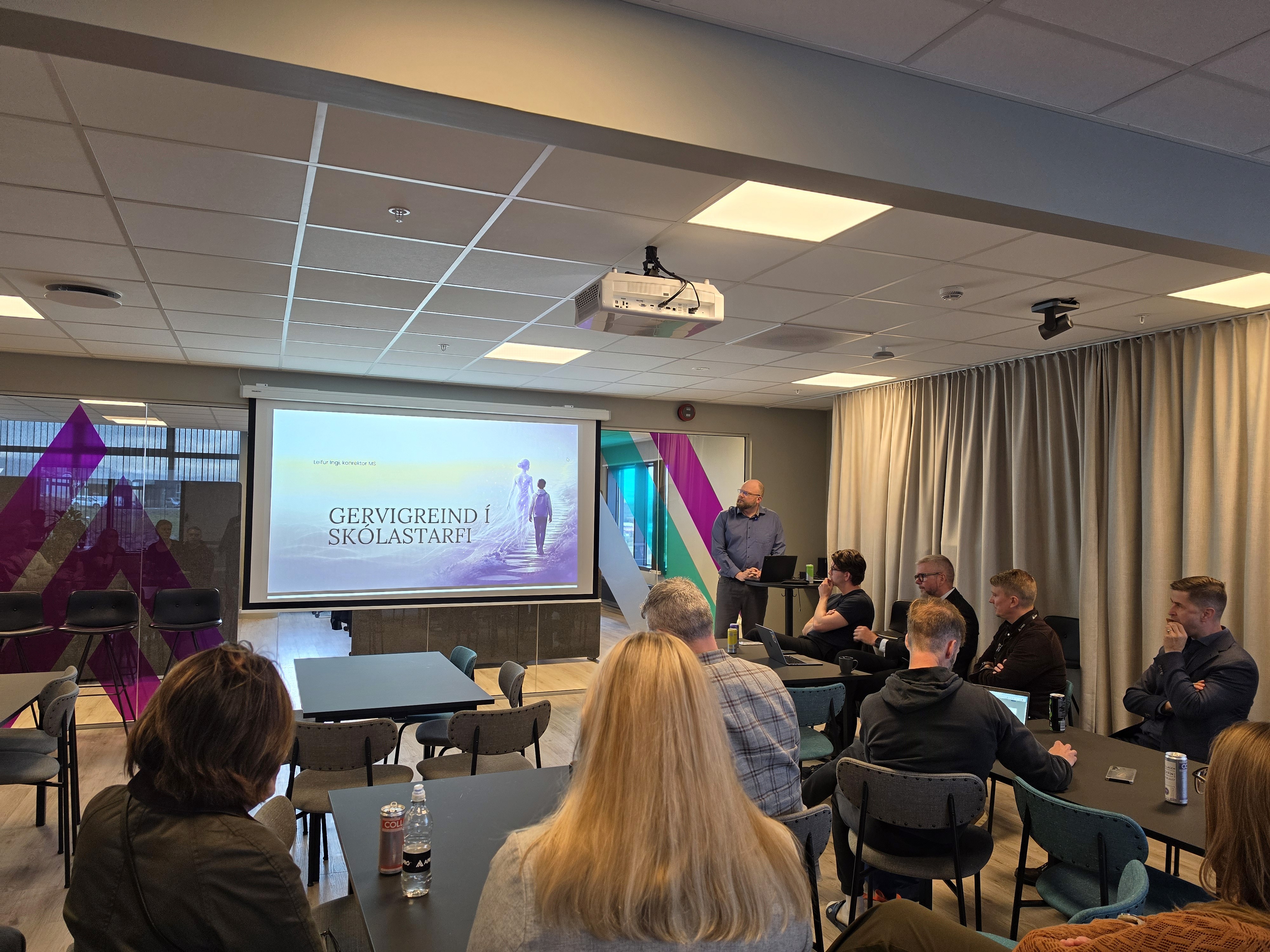
In August, APRÓ invited teachers, administrators, consultants, and others involved in school work to a conversation about the use of artificial intelligence in Icelandic secondary schools. The goal was not to hold a general presentation on AI, but to hear real-world experiences from Icelandic schools—what is already being tested, what has gone well, what challenges have arisen, and what we can learn from each other. It quickly became clear that AI is no longer a future concept for the school system. Teachers and students are already using the technology, and in many places, new approaches are being tested in teaching, materials creation, project work, and feedback.
The question is therefore not whether AI will increasingly become a part of school work, but how we utilize it in a responsible and targeted manner in a modern school system.
New tools call for new skills
Gísli Ragnar Guðmundsson from Almannarómur discussed how artificial intelligence is changing the conditions for learning and teaching. One of the questions he posed was simple but important:
"What can a teacher or student now try that previously would have required more time or expert assistance?"
As it becomes easier to produce text, analysis, and other content, it simultaneously becomes more important to look to the skills behind it: judgment, professional expertise, critical thinking, and the ability to evaluate and verify results. The same theme was clear in teachers' experiences. Tinna and Fríða from Fjölbrautaskólinn í Garðabæ pointed out that students need, among other things, to learn how to formulate good questions, critically evaluate AI answers, work with the technology, and continue to take responsibility for their submissions. In this way, AI does not replace the student or the teacher, but is a new tool that teachers and students must learn to use.
Real-world use has already begun
At the event, various examples were shown of how teachers are already using AI in their work. Tinna and Fríða from Fjölbrautaskóli Garðabæjar demonstrated, among other things, how they have used the technology for project design, creating assessment rubrics, feedback, and customized chatbots that know the curriculum and can guide students without solving the tasks for them. Bogi Ragnarsson showed how AI can be useful in developing teaching materials and projects. There, the focus was clear: the teacher provides the professional expertise and learning objectives, the AI assists with processing and formatting, and the teacher is responsible for the final product. Leifur Ingi, deputy headmaster of Menntaskólinn við Sund, also discussed the opportunities inherent in new possibilities for teaching materials design, meeting students in new ways, and developing school work in step with society.
The examples showed that the discussion is already shifting from asking what AI can do to a much more practical question: Where can it improve learning and teaching?
Technology alone is not enough
One of the key points that emerged clearly in the discussions was that good AI tools alone do not guarantee a successful implementation. Petra Pétursdóttir from APRÓ reviewed experiences from implementation projects and the bottlenecks that can arise. There, change management, training, motivation, security, and clear prerequisites matter just as much as the technology itself. Teachers and staff need to be supported, space must be created for experimentation, and a shared understanding must be built regarding how and when the technology should be used.
This applies no less to students. The goal is not for AI to do the assignments for them, but for them to learn to utilize it as a tool while maintaining responsibility for their own learning.
We do not all need to solve the same problems individually in our own corners
Perhaps the most important lesson from the conversation was that many of the issues schools are facing are shared.
How should we approach assessment when students have access to powerful AI? What skills will become more important? How do we support teachers? What rules need to be clear? How do we ensure security and privacy? And what technical infrastructure needs to be in place?
These are questions and challenges that each school does not necessarily have to solve from scratch. One of the main focuses of the event was precisely to connect schools, authorities, and experts, share experiences, and discuss how to learn more from one another.
There are great opportunities in increased collaboration and joint knowledge building, while it is also important to create sufficient flexibility for the diverse needs of schools, teachers, and students.
The conversation continues
We at APRÓ want to continue creating a platform for this conversation and contribute with the knowledge we have built up on AI implementation, technical execution, security, and change management. The goal is not to find a single solution that everyone should use, but to help create good conditions for the safe, flexible, and purposeful use of AI in Icelandic education.
We thank everyone who participated in the event, both those who shared their experiences and those who took part in the discussion.
This was hopefully just the beginning of an ongoing conversation and collaboration on AI in the Icelandic education system.