Creative Destruction in Motion
Why are investors afraid of the future when it's so exciting?

Andri Örvar Baldvinsson
Insights
Market turbulence
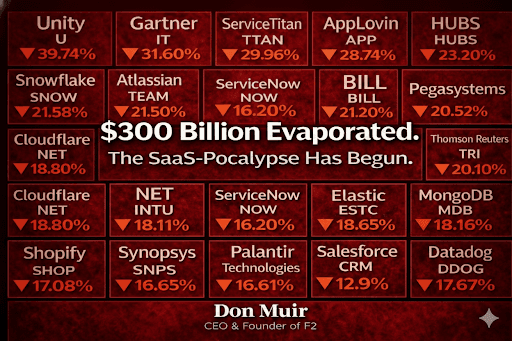
If you look at the IGV index for software companies in February 2026, you'll see red numbers on markets that might look like a crash—stocks have dropped 20-30% in a short time (ServiceNow, Atlassian, Salesforce, and others). What's striking about the market's response is that this isn't about companies missing their numbers or underperforming. In fact, many of these companies are running well, and profits are growing in most cases.
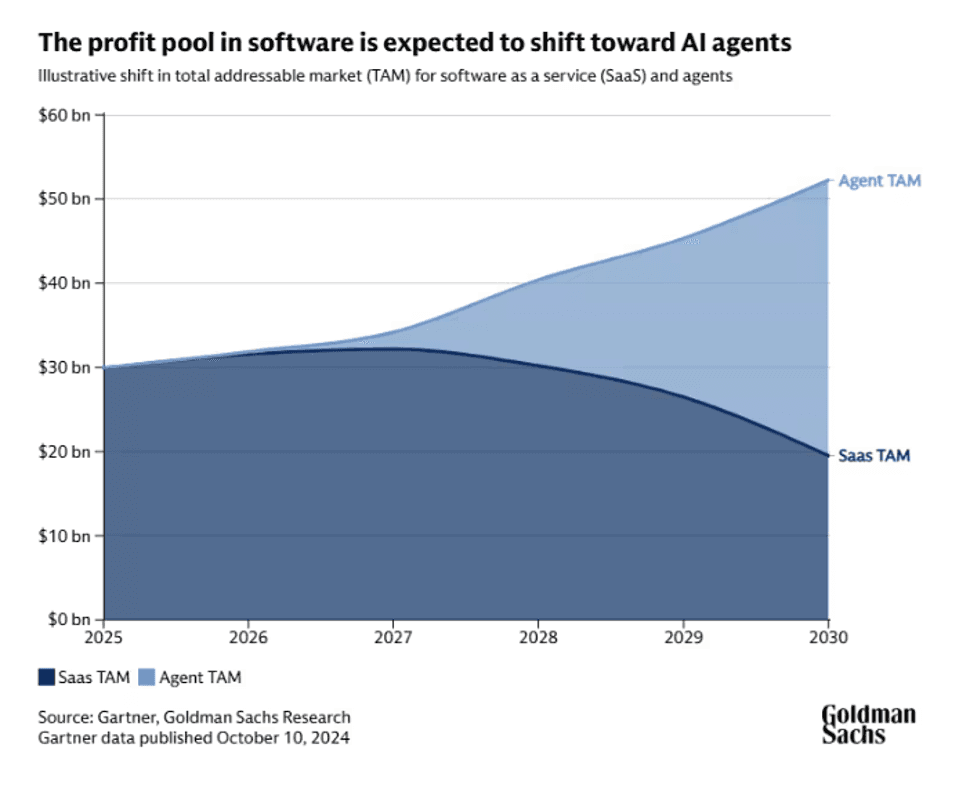
Forecasts from analysts like Gartner and Goldman Sachs, though, aren't helping calm investor nerves. They see a systematic shift of capital that threatens the revenue streams of software companies. As you can see in the chart below, the overall market for traditional software rentals (SaaS) is expected to peak around 2027 and then shrink significantly.
At the same time, the market for AI agents is taking off and growing so fast that it will dwarf the old model by 2030.
The drop really comes from investor fear. They believe that with AI, established business models are at risk. The model of selling licenses per user might be running its course, and real uncertainty exists about whether these tools will be needed in their current form in the future. That change naturally brings significant turbulence, though most signs point to new business models where you pay for actual usage or even direct results on projects—rather than just renting access to software.
2025 was the year AI informed us; 2026 is the year it starts doing the work
The shift between 2025 and 2026 marks a fundamental change in how technology plays a role in our daily lives.
In 2025, AI was our main "assistant"—we could ask it questions, get ideas, or have it pull together work documents to make us a bit faster.
In 2026, we've made the leap to AI actually doing the work through what are called AI agents.
What is an "agent" in plain terms?
To understand this shift, think about the difference between a tool and labor:
The old way (SaaS): Like buying a power drill that you had to know how to use and do the work yourself.
An agent: Like hiring a carpenter—you don't need to know how to use the drill. You just tell them where you want the shelf, and they show up, plan the job, and finish it.
Agents are digital coworkers that can manage tasks exactly like a person does. They can go into your accounting system, compare complex data, and complete work on their own—without you clicking a single button. And now you can manage whole teams of these AI agents working together on the goals you set for them.
Tech and infrastructure giants will become the world's largest employers
Investors see that the companies supplying us with AI are gradually becoming the world's largest employers, which is why expectations for them run so high.
Sam Altman (OpenAI): Believes that digital intelligence is becoming the new electricity. The goal is to make AI labor so cheap and accessible that one person can manage entire teams of digital employees.
Thomas Kurian (Google Cloud): While some predict the death of traditional software, Kurian says software will survive but its role will change. It will become the fuel (the data) that AI agents use to get work done.
Andy Jassy (AWS): He sees AWS as the "recruiting firm" of the future where you rent billions of AI agents to do your work.
Satya Nadella (Microsoft): He believes traditional software will fade away because AI agents will do the work that users used to do.
Jensen Huang (Nvidia): He talks about "AI factories" and predicts that the biggest infrastructure buildup in history now centers on converting electricity into digital intelligence—and he's supplying the infrastructure to do it.
Larry Ellison (Oracle): Ellison is now building nuclear-powered data centers to ensure that AI agents have enough power to work with enterprise data.
Zuckerberg (Meta): He says they're not selling AI but using it to make their services essential to us. He wants to own the ecosystem where the work happens.
Elon Musk: Musk predicts that work will eventually become a "hobby" as AI and robots (like Optimus) handle production instead of people.
The foundation: Power and data centers
While these visions are exciting, they rest on a reality that demands unprecedented resources. AI isn't going anywhere, and it needs massive amounts of power to function.
When we let it solve problems for us, it demands enormous energy and computing power, which explains the huge investment in infrastructure across the United States and strong government support for data center development.
Governments see where this is headed: power and computing capacity are now the new oil—and a critical national security issue for the United States.
Work is moving to the cloud
We're experiencing a massive shift in costs as markets try to figure out how to price a future where work isn't measured in employees at a desk. Instead of paying an employee a salary to use a computer for traditional office work, spending is increasingly moving to the tech and infrastructure companies that supply us with this digital labor.
Work is now being measured in "tokens"—which are really digital units representing the digital intelligence and work that AI does for you.
The software rental business model is undergoing fundamental change. We're gradually moving away from paying for access to tools and starting to buy the work that they deliver.
Conclusion
This market turbulence is really creative destruction—the old making way for the new.
The market isn't rejecting the future; it's simply trying to figure out where the value will be created.
While the big tech and infrastructure giants are laying the foundation and supplying the digital intelligence, it's far from certain who will come out on top in this race.
It's entirely possible that startups building on top of this infrastructure will capture a large share of the value.
We're at a crossroads where value is shifting from using the tools themselves to the results they deliver. When we stop paying for software access and start paying for AI agents to do the work, everything changes in how we measure value.
The future won't be measured just in the number of employees, but in digital intelligence powered by "tokens" and energy.