Should We Change Course With VMware?
An article about how companies are rethinking their infrastructure management based on both business and technology considerations.

Andri Örvar Baldvinsson
Insights
VMware is undoubtedly one of the major players in virtualization and data centers worldwide, and for more than two decades has been one of the most important foundations for infrastructure operations at Icelandic companies. That's why many businesses have invested heavily in their infrastructure and built up employee knowledge and experience around VMware solutions.
VMware specialists in Iceland have in many cases provided stable, reliable operations for companies, so it's completely natural that there hasn't been a reason to look at other options.
And that matters greatly — not just technically, but for the entire organization.
But the landscape has changed following Broadcom's acquisition of VMware at the end of 2023, when new subscription models were introduced, customer contracts were terminated, product categories were consolidated meaning you might even be paying for licenses you don't use along with higher licensing costs that have prompted many companies to reconsider their infrastructure future (source).
These questions about whether companies should change course have been confirmed by a recent Gartner Community survey, which found that 73% of VMware customers are exploring other options (source).
Why are companies reassessing the situation?
While rising licensing costs have sparked the conversation about making changes, the reasons are actually much broader. When companies look at this seriously, they see it's both a business and technical matter — and these two sides often go hand in hand.
On the business side, we see rising licensing costs, challenges around CAPEX and OPEX, and growing demand for flexibility in operating models. Companies want more speed to respond to changing market conditions, to test and experiment without locking into too much CAPEX spending, and to have more control.
On the technical side, the most common reasons are reducing technical debt, improving security and scalability, and simplifying operations — even with the goal of reducing the number of hardware vendors. Companies with high technical debt often turn to cloud solutions as a way to untangle the knots that have accumulated over the years.
This isn't about VMware not performing well, but rather that the environment around operations, cost models, and expectations and requirements for infrastructure management are changing.
Should we stay the same but switch vendors?
It's not surprising that many companies are considering alternatives like Nutanix, Hyper-V, or KVM for their infrastructure operations.
These are solutions that are well-known here and can be more cost-effective now that VMware licensing has changed. Companies that want to continue on the same path with the same operating model (CAPEX), use the same hardware and data centers but with a new vendor, find that this path can be very sensible.
However, it's important to keep in mind that this is primarily a vendor switch, not a change in approach. The environment, the data center, the hardware — everything stays the same and doesn't change.
Would AWS cloud be a good option?
Cloud solutions have in recent years become realistic alternatives to traditional infrastructure operations. Companies that have adopted this approach now benefit from greater flexibility, better service levels, speed, and scalability that are difficult to achieve with older setups.
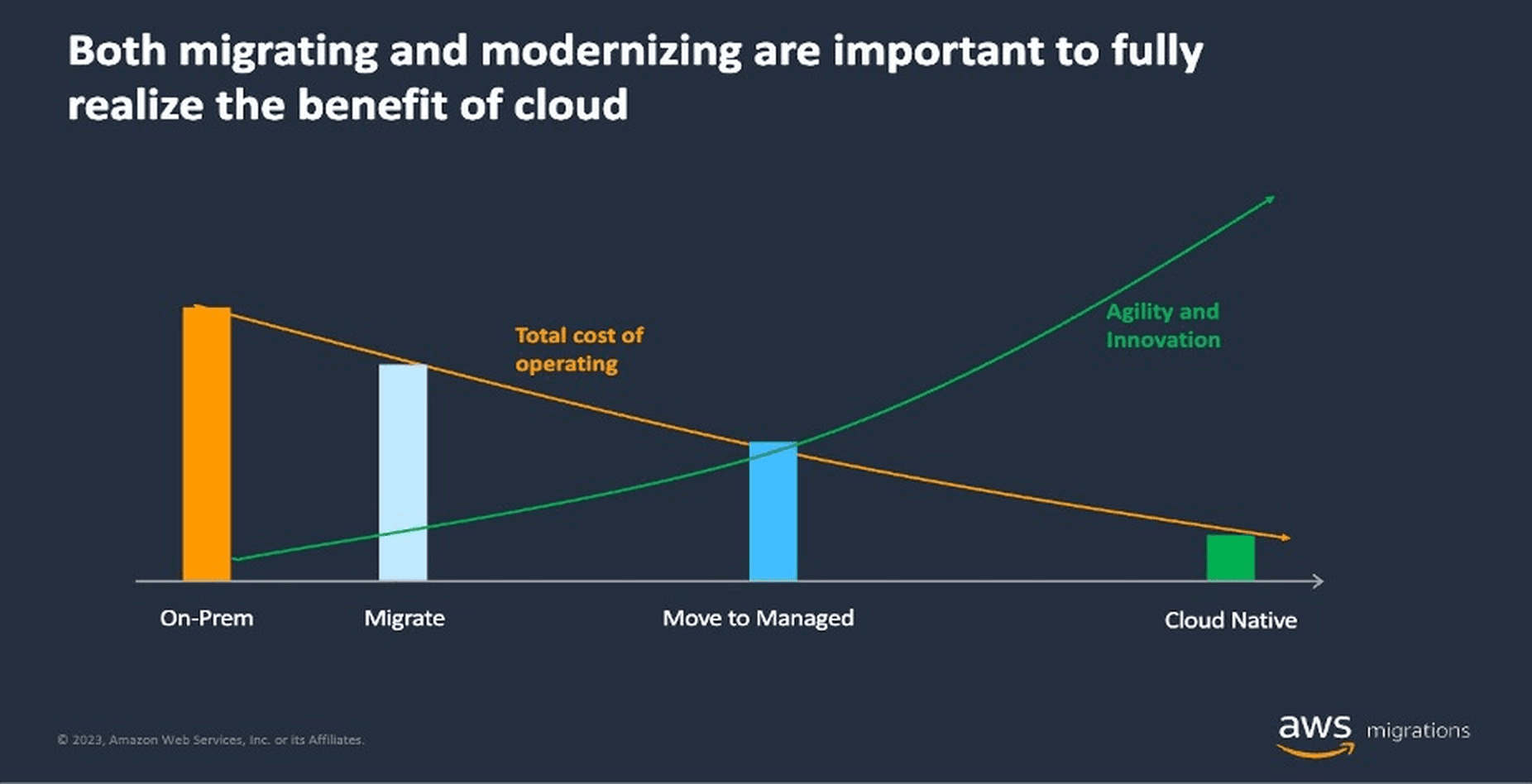
Image (source)
The image above illustrates this well: when companies move from traditional "on-prem" environments — with hardware vendors and data centers — to cloud solutions, operating costs gradually decrease, while flexibility and other opportunities increase.
With AWS, much of the work that was previously required in server rooms and data centers — such as hardware, security updates, backups, disaster recovery, scalability, and even database operations — shifts to a service layer that AWS manages entirely. Companies gain more time and can direct their workforce to focus on other tasks instead of continuous maintenance work.
The image underscores that moving to the cloud is the first step, but modernizing systems creates real value. Companies can start by moving workloads to the cloud without changing everything, and begin operating differently with infrastructure and operations. This doesn't necessarily mean costs drop immediately in the first steps, but it opens up possibilities for better optimization in operations that are harder to achieve in on-prem environments — through automation, better visibility, flexibility, and transparency in operating costs. When systems are updated to managed or cloud-native services, the benefits multiply with less complexity, less technical debt, and faster innovation.
AWS has invested significant effort in making it easier for companies to get to the cloud. Tools like AWS Transform for VMware make the migration process safer, simpler, and more efficient using artificial intelligence, and can substantially reduce project scope (source).
It's also interesting how quickly these transformations can happen. Danske Bank, for example, began moving their infrastructure to AWS with the goal of becoming a leading "digital-first" bank. In the project, they moved over 16,600 servers and more than 60,000 "containers" — services in Kubernetes — and with automation and the right tools from AWS, they reduced the project scope by 50%.
This example reflects well how far AWS has come in making cloud migration efficient, in a secure way, and causing less disruption to operations than was previously possible (source).
APRÓ supports your company
APRÓ is one of few companies in Iceland that has built specialized teams around AWS products and services. We employ certified AWS Solutions Architects, security and DevOps experts with many years of experience migrating companies from traditional infrastructure to AWS safely and efficiently.

We help companies assess their current situation, design the right solution, and execute migrations from VMware and other on-prem environments with minimal disruption. With the right approach, we help our customers reduce operating costs, eliminate technical debt, and build cloud solutions using modern approaches and better use of resources.
Companies that work with APRÓ gain easy access to teams with extensive AWS experience and recognized certifications who can guide them through the entire journey to the cloud, from initial assessment to implementation.
Are you thinking about changing course? Or curious about the possibilities in the cloud and whether it's right for you and your business? Contact us and we'll tell you everything in plain language.