The Cloud Giants: Fast-Paced Changes
This is the second article of six. In part 1, I explained what a data processing agreement is and why Icelandic business needs to watch carefully for changes to them.
The Broken Promise, part 2.

Andri Örvar Baldvinsson
Articles
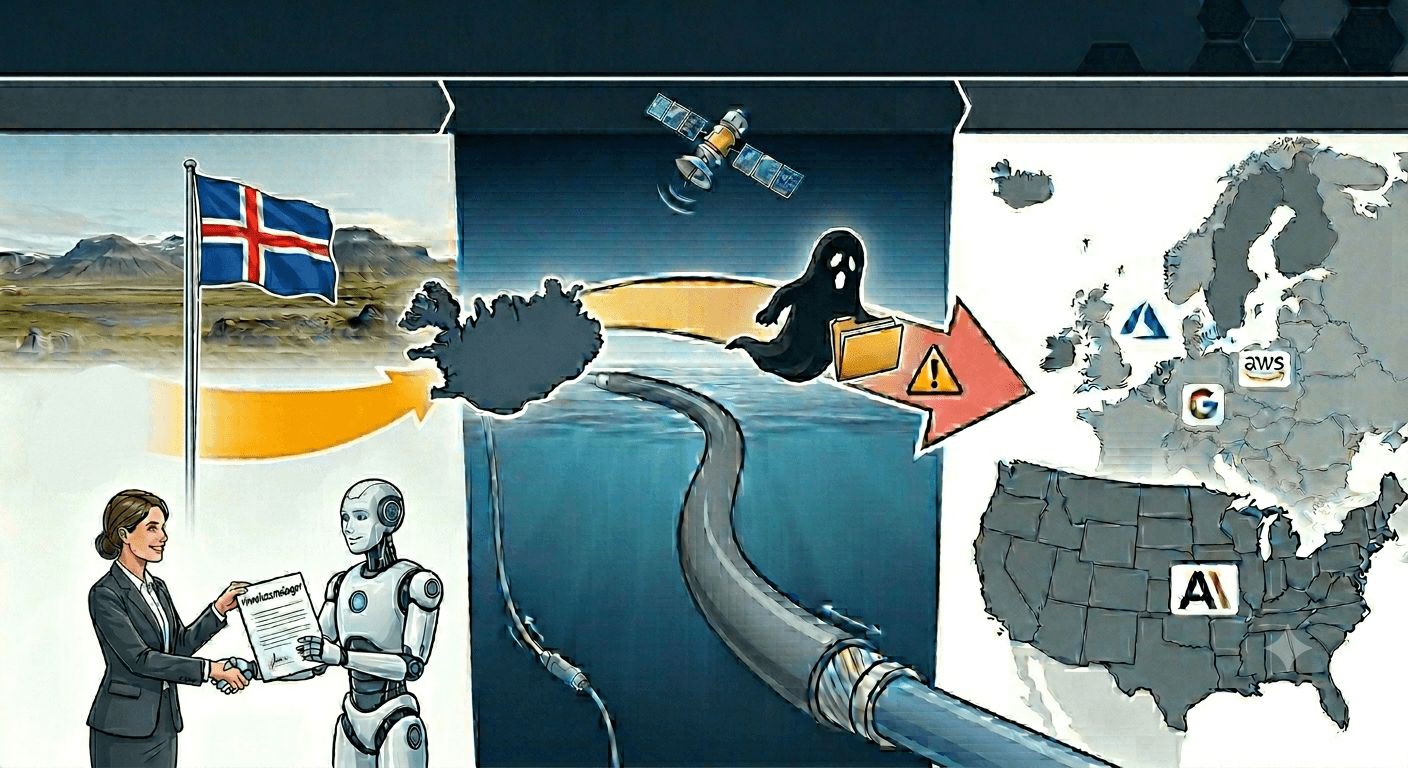
I'm covering the major shifts that have shaken the AI market over the past few months and why companies choose to go through cloud providers rather than directly with model makers. In part 3, I'll bring together all the ways I know of to access these models and how to implement them.
Over recent months, the big players in AI have been making deals with each other that many might have missed, and some of what you thought you knew about data security and location could have changed.
Microsoft and Anthropic
In January 2026, Anthropic became a subprocessor for Microsoft 365 Copilot, and in May 2026, Claude became the default model in Copilot for Excel and PowerPoint (with Word coming soon). From a user's perspective, it's straightforward: you open Excel, ask Copilot to analyze your sales figures, and it's likely Claude that answers.
But there's a complication, as stated in Microsoft's public documentation:
„Anthropic models are out of scope for the EU Data Boundary and when available, in-country LLM processing commitments."
In practical terms: when Claude processes your Copilot request, even from an Excel file stored on a European Azure region, the actual processing happens outside the European data boundary (EU Data Boundary). This applies when Claude is being used, but OpenAI models in Copilot stay within the EU Data Boundary for European cloud environments (EU/EFTA-tenants), as they always have.
Microsoft has actually disabled this feature in tenants within the EU, EFTA, and UK, but enabled it by default everywhere else. I'm fairly confident that some companies and organizations here at home have simply turned this feature on manually and are just assuming it's fine for certain tasks that AI is solving for them.
The situation is changing, though: Microsoft has committed to moving Claude processing to its own Azure regions in Sweden Central and possibly Germany West Central sometime in 2026.
Today, Claude runs on infrastructure that Anthropic manages, but while we wait for the migration to a European Azure environment, the situation is clear: Claude processing is outside the EU Data Boundary.
3P mode and when Claude tools talk to cloud providers
Before we continue, it's worth explaining a concept that matters: what Anthropic calls „3P mode" (third-party mode). This is a pattern that allows Claude Code, Claude Desktop, and the Anthropic SDK to route requests through a third party instead of going directly to Anthropic.
People familiar with Claude tools get almost the same experience, except they're within a European jurisdiction.
Today, these tools support two 3P routes that keep data within Europe*:
Amazon Bedrock
Google Cloud Vertex AI
*Microsoft Foundry is an option but processing is currently in the US
You get the same model you'd get directly from Anthropic but now operate under AWS DPA or Google DPA, and the model runs within the EU Data Boundary when you select a European region. Your data never leaves the cloud provider you've chosen.
This is a critical option for companies already using Bedrock or Vertex who want to align their environments, or who need to keep data within Europe.
Cowork – the same product, three different paths
Claude Cowork is a relatively new feature from Anthropic that solves complex problems across multiple steps independently. It can read documents, run research, work with files, and deliver completed projects. Thisis exactly the shift I wrote about in my piece on digital assistants: we're moving from paying for access to tools to paying for the work they deliver.
Cowork is now available through three different routes, each with different data protection implications:
Cowork directly from Anthropic runs on Anthropic's infrastructure in the United States. No option for European hosting. This is the default setup when an employee downloads Claude Desktop from claude.ai.
Cowork in Microsoft 365 (Copilot Cowork, launched in March 2026) runs on Anthropic-managed infrastructure, outside the EU Data Boundary, under Microsoft Enterprise Data Protection terms. This is one reason Cowork hasn't yet been rolled out by default for European Microsoft tenants.
Cowork in Amazon Bedrock (launched in April 2026) is a 3P mode implementation where Cowork runs on the same AWS infrastructure as Bedrock itself. Processing happens within AWS in the region you choose: Frankfurt, Stockholm, or Ireland, and your data never leaves your AWS environment. This is the key point: Cowork in Bedrock keeps you within the EU Data Boundary, unlike both other paths.
These are three routes where Microsoft's Cowork sends your data to the United States like Cowork directly from Anthropic does, but AWS's Cowork keeps it within Europe.
That said, it's worth noting that Cowork in Bedrock doesn't support all Cowork features, but we see the same pattern with 3P mode generally: when you go through a cloud provider instead of using Anthropic directly, you don't get the full Claude experience, but the version that the cloud provider's infrastructure supports.
Here we need to pause and evaluate whether features outweigh where your data is processed.
Why do companies go through cloud providers at all?
Some readers are probably wondering: if Claude is used directly with Anthropic, isn't that the simplest route? Why would companies choose to go through Microsoft Foundry, Amazon Bedrock, or Vertex AI? That's a fair and good question, and here's how to answer it.
Data protection. As we've seen, Anthropic is always outside the EU Data Boundary, and if your company needs to keep data within Europe because of GDPR, then Bedrock or Vertex AI are currently the only realistic options for European data governance. Azure Foundry/Copilot should be coming later this year.
The tech stack. Many companies already using AWS, Azure, or Google Cloud have built knowledge and technical infrastructure like data stores in S3 buckets, databases in Aurora, Azure AI Search over internal document collections, or Vertex AI Workbench for data science teams.
When you're building complex solutions that use Claude on this data – like RAG systems (retrieval-augmented generation) that search internal data stores, or agentic systems that run multiple steps at once – you may want the model on the same tech stack you've chosen. Bedrock Agents, Bedrock Knowledge Bases, Azure AI Search, and Vertex AI Agents all offer such integrations within their own environment.
Big data stores and complex tasks are the best example. When you're working with millions of documents, need to ask Claude questions about them, and must keep everything within a specific region, it's simpler to run the model directly in Bedrock or Vertex than to move data in and out or between cloud providers.
Billing and contracts. Many companies already have contracts with AWS, Azure, or Google, and adding an Anthropic contract means a new service agreement, a new risk assessment, a new vendor sending you invoices, and new vendor relationships. If you can get the same service from a vendor you already work with, that simplifies administration.
In short: it's not just about "using Claude" but about how you use Claude and where you want your data to be while you do it.
AWS and Microsoft in the same boat
AWS has also been making deals that are changing the landscape. In May 2026, AWS introduced a path called Claude Platform on AWS where Anthropic manages processing but AWS handles authentication and billing. On the surface, it looks like an AWS service, but your data goes outside AWS and is processed on Anthropic-managed infrastructure in the United States. No European regions are available for this route.
At the same time, AWS added OpenAI models to Amazon Bedrock, which was a historic moment because OpenAI's exclusive deal with Microsoft was broken, and GPT models became available outside Azure for the first time. But these models are currently only available in the United States – no European regions yet for GPT on Bedrock.
This means AWS and Microsoft are now in the same position but inverted:
Cloud Provider | Native model in EU | Competitor's model today |
|---|---|---|
Microsoft | OpenAI (within EU Data Boundary) | Claude (outside, US today) |
AWS | Claude (within EU Data Boundary) | OpenAI (outside, US today) |
Gemini (within) | Claude (within, Frankfurt since 2024) |
When new models become available through deals between leading players in this field, they need time to migrate to the cloud provider's own infrastructure, and until then they run on the model maker's US infrastructure. Google stands out because Claude has been available in Frankfurt on Vertex AI since March 2024, and Anthropic and Google have worked closely together from the start.
OpenAI and the European path
Now we come to OpenAI, which many Icelandic companies use daily through ChatGPT subscriptions for employees or through APIs for development teams.
OpenAI took a different approach than Anthropic. In February 2025, they began offering European "data residency" for ChatGPT Enterprise, ChatGPT Edu, and their API Platform, and in November 2025, they expanded to ten regions worldwide.
This works differently by product:
OpenAI API Platform: Development teams can create a "Project" with Europe as the region, and requests are processed within the EU.
ChatGPT Enterprise and Edu: Both offer "data residency" and inference residency (the actual processing happens in Europe). Data never leaves the region.
ChatGPT Team: A smaller business subscription. Data isn't used for training, but it's stored in the United States with no European option.
ChatGPT Plus and Free: Individual subscriptions. No European option, and data is used for training by default unless you turn it off manually.
This is a major difference from Anthropic, where no European data hosting is available for Pro, Max, or Team subscriptions – they're all in the United States.
What's interesting is that even though OpenAI is ahead of Anthropic on European hosting, this option only benefits those using business subscriptions. The employee who opens chatgpt.com on a personal subscription and pastes in a work document is still in the same situation as three years ago – data goes to the United States and is shared for training by default.
This matters more than many realize. Many Icelandic companies have no formal policy on which AI tools employees use daily, and sensitive information often travels west across the ocean without the employer ever having knowingly approved it.
Anthropic expands in Europe
One thing worth mentioning at the end: Anthropic is now opening offices across Europe. From their recent announcements, we see offices in London (about 200 employees), Dublin, and Zurich, and they opened new offices in Paris and Munich in November 2025 and in Milan in May 2026.
Anthropic says EMEA is their fastest-growing region with „9x runrate revenue growth" over the past year. Major European customers like L'Oréal, BMW, SAP, Sanofi, and N26 now use Claude in daily operations.
Until now, these offices have primarily served Anthropic's sales work rather than technical infrastructure, but it wouldn't be surprising if Anthropic moves in OpenAI's direction and eventually offers similar European data hosting options like OpenAI does today.
Before I bring all the paths together in the next section, here's an interactive table to orient yourself on the landscape – filter it by processor or EU Data Boundary to see how the same models work across regions:
In the next article, part 3, I'll bring together all the paths to the same models in one table and explore why the difference matters.